
Your child's future depends on decisions you don't know you need to make yet.
Most families don't find out about the waiting lists, the benefit rules, and the planning windows until it's too late to use them. Special Needs Navigator™ gives you a clear picture of what's coming - before you miss it.
Family Mode from $14.99 · Professional Mode from $34.99
The system won't tell you what your child is entitled to. You have to know to ask.
There are waiting lists your child should be on right now - some with 10 to 15-year waits. There are benefits that require an application years before your child needs them. There are planning decisions that close permanently once your child turns 18, 21, or 26.
Nobody sends you a letter. The school won't always bring it up. The military's family support system won't always catch it. And by the time you're sitting in an attorney's office or a benefits counselor's waiting room, some of those windows are already closed.
That's not a failure of effort. That's a failure of information.
I built this because I missed windows I can't get back.
I'm Eric Jorgensen - a CFP®, a retired Navy Chief, and the father of a son who is significantly impacted by his disability.
My wife died in April 2012. I retired from the Navy eight months later. In the middle of grief, I started asking questions I should have been asking for years - and found out that the answers had been available the whole time. Services my son could have had. Waiting lists we could have been on. A waiver program with a 12-year wait that we were just finding out existed.
The school knew some of it. The EFMP office knew some of it. Nobody put it together and handed it to me.
I spent the next decade learning the system — SSI, Medicaid waivers, Special Needs Trusts, DAC benefits, VA benefits — through trial, error, and professional training. I built Special Needs Navigator™ so families wouldn't have to learn the same way I did.
Sage keeps learning too. Every time it misses something, real families catch it, and it gets fixed — not tested once and left alone.
Special Needs Navigator™ is what I wish had existed in 2012.
A starting point, not a shortcut.
Sage is not a replacement for an attorney or a financial planner. You will still need professionals - and for some decisions, you should hire one before you do anything else.
What Sage does is get you ready for those conversations. It helps you understand which benefits apply to your family, what the risks are, what questions to ask, and what order to do things in. Families who walk into professional consultations knowing the right questions get better outcomes.
Sage is the guide that gets you to the right professional - ready.
Three steps. Real guidance. No waiting room.
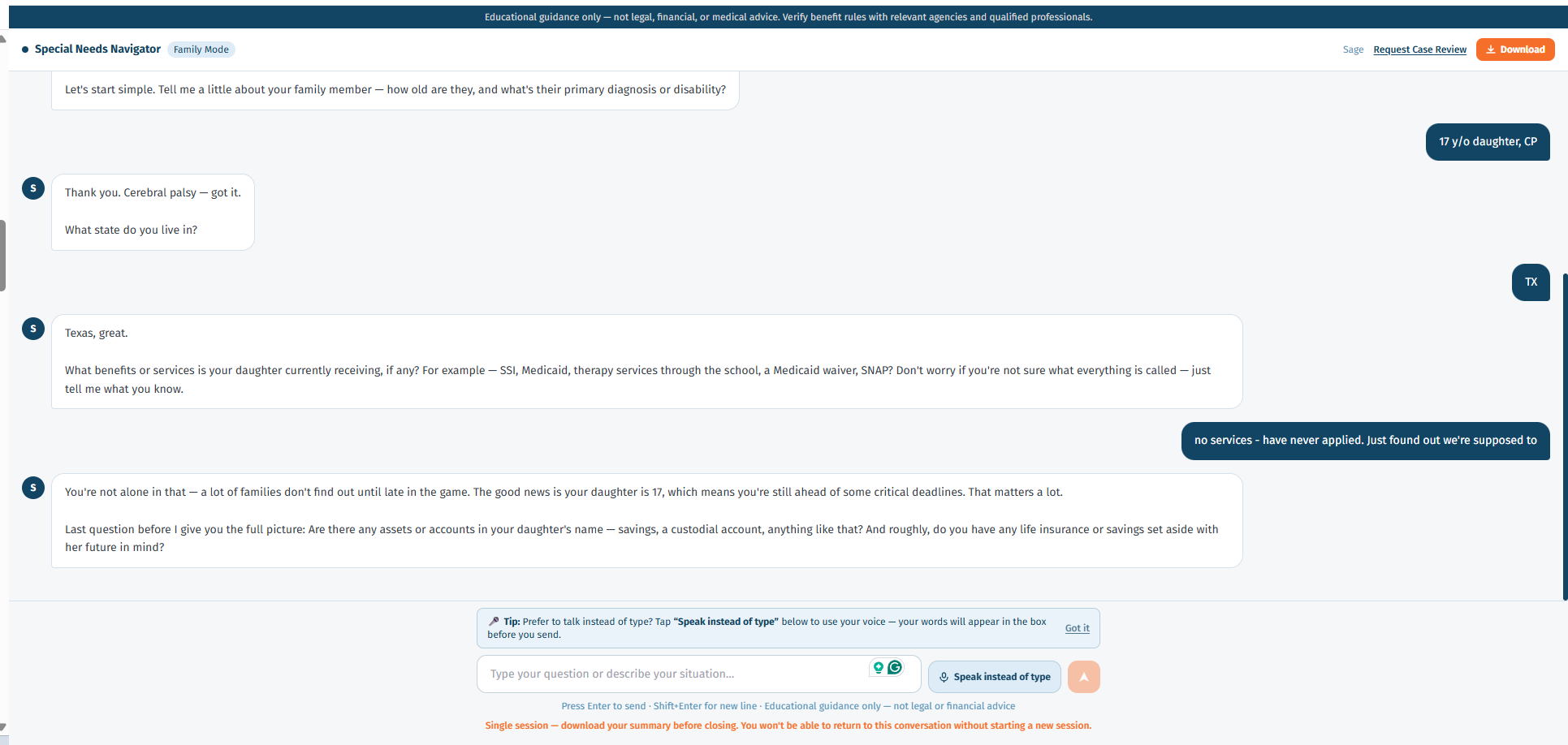
Step 1 - Tell Sage about your situation. Your family member's age, disability, current benefits, and what you're trying to figure out. No forms. No referrals. Just a conversation.
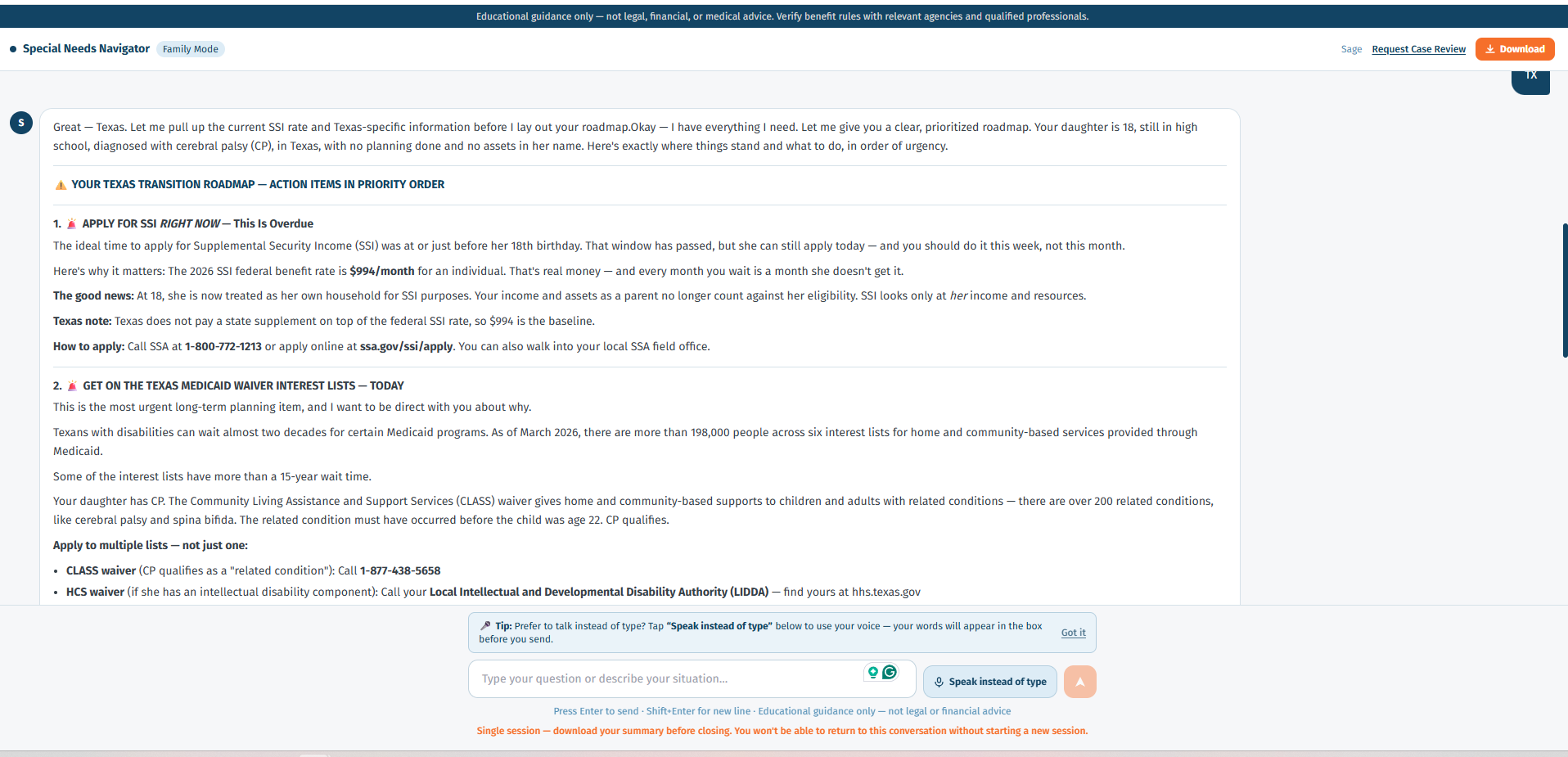
Step 2 - Get guidance specific to your situation. Sage walks you through the relevant benefit rules, planning considerations, and risks — including things you didn't know to ask about.
Step 3 - Know your next move. You'll leave with a clear picture of your options, what to do first, and when to bring in a professional. You can download a full session summary to take into your next appointment.
Free planning guidance
Not ready for a session yet?
Get weekly insights on SSI, Medicaid, special needs trusts, and long-term planning — written plainly, for families navigating this alone.
No spam. Unsubscribe anytime.
What it's used for
Does any of this sound familiar?
These are the kinds of situations Special Needs Navigator is built for.
You don't know what you don't know — and that's exactly the problem.
Your child has a disability. You've heard terms like SSI, Special Needs Trust, and Medicaid waiver but you're not sure which ones apply to your family, in what order, or how urgent any of it is. That's where most families are. It's also where the biggest mistakes happen, not because families don't care, but because nobody gave them a map.
Your child is approaching 18, 21, or 22 and the clock is running.
The transition out of school-based services is one of the highest-stakes planning moments in a disabled person's life. Benefits change, eligibility rules shift, and some services stop entirely. The families who navigate it well are the ones who started planning two to three years earlier than they thought they needed to.
Your child is turning 18 and SSI has new rules.
At 18, Social Security re-evaluates your child using adult disability standards, not the childhood standard used when they first qualified. Most parents have never heard of this process until they're already inside it.
A grandparent left money to your child and this needs attention.
SSI has strict resource limits. An unexpected inheritance can create a serious planning problem and the window to respond is short. This is one of the most common situations families bring to a disability planner, and one of the most preventable.
You're nearing retirement and your child may now qualify for more.
When a parent files for Social Security retirement or disability benefits, a disabled adult child may become eligible for DAC benefits, often a larger and more stable benefit than SSI. Most families never get told this exists.
You're retiring from the military and your disabled child needs to be on your SBP.
The Survivor Benefit Plan election happens once, at retirement, and it is largely irrevocable. If you have a disabled adult child, that decision affects their income and coverage for the rest of their life. Most service members don't get the guidance they need before they sign the paperwork.
Military family — TRICARE, Medicaid waivers, and EFMP all at once.
Every PCS move can affect your child's Medicaid waiver standing. TRICARE ECHO, EFMP, and state Medicaid waivers all interact and different people will tell you different things about how.
Federal employee — keeping your disabled child on FEHB past 26.
There is a process to continue FEHB coverage for a disabled dependent past age 26 but it requires documentation and the right timing. Most federal employees don't find out it exists until they're already scrambling.
Benefits counselor or nonprofit staff — get a faster answer for your client.
You're working with families every day, but benefit interactions are complicated and the rules change. Get a structured way to think through SSI, DAC, Medicaid waiver, and employment questions without spending an hour hunting through SSA manuals.
The planning windows are open right now. Some of them won't be for long.
A planning conversation with Sage costs less than a single hour with most advisors. Take as long as you need - you'll leave knowing more than you did, and knowing what to do next.
Family Mode from $14.99 · Professional Mode from $34.99
Questions? Email eric@specialneedsnavigator.us
“The beauty of Sage is that it is trained on Eric’s knowledge and data, and is about 10 billion times more useful than the output generated by an untrained AI.”
“I was most impressed with how easy it was to understand the information Sage provided. When able, Sage provided step-by-step guides on not only what to do but, what to say. Sage took things a step further and provided the reasoning behind specific steps which I believe is the starting point for families and professionals to begin understanding the inter-workings of benefits.”
“The Sage AI tool is a trusted resource for the disability community. Families now have a digital assistant, created by a leader in the disability planning community, that they can use to find the answers to many of the questions they have about their loved one’s future.”
“The reminders of things mentioned in prior searches and summaries of things to do are very helpful. We need to receive the information multiple times because there is so much to learn.”